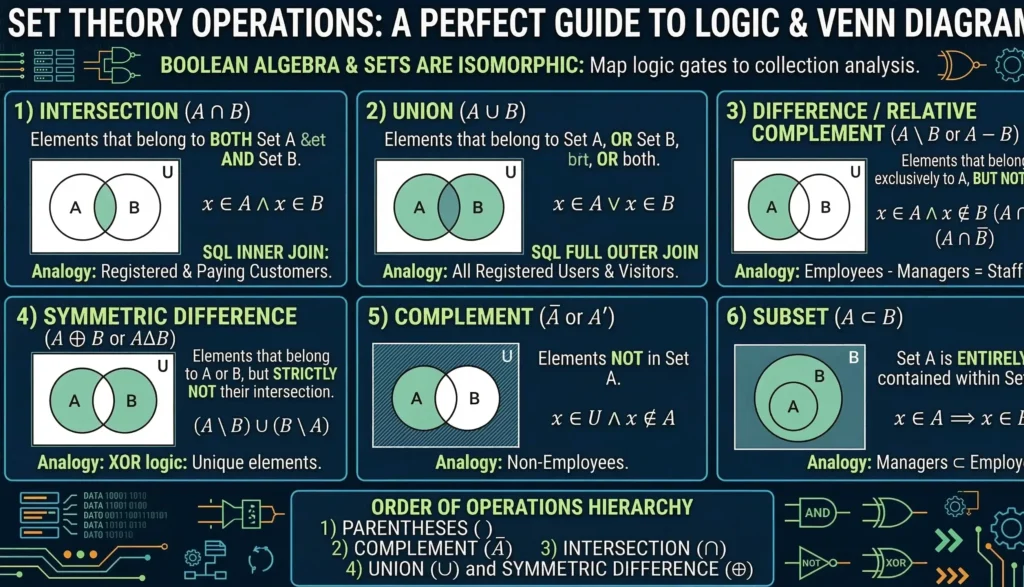
If you have already mastered Boolean algebra truth tables, transitioning to discrete mathematics’ next major topic will feel incredibly natural. The logical principles that govern individual bits of data (1s and 0s) are exactly the same principles that govern massive collections of data. This mathematical framework is known as set theory.
Understanding set theory operations is absolutely essential for modern computer science. Every time a software engineer writes an SQL query to retrieve data from a relational database, they are actively applying these mathematical laws. Introduced by Georg Cantor and visually perfected by John Venn, this system allows us to manipulate infinite groups of objects with mathematical precision.
In this comprehensive guide, we will explore the profound connection between Boolean logic and sets, visualize relationships using Euler-Venn diagrams, and solve complex algebraic identities step-by-step.
1. The Bridge Between Boolean Algebra and Sets
Set theory and Boolean algebra are structurally identical; they are mathematically isomorphic. This means every operation you learned in logic has a direct, one-to-one equivalent in set theory. Instead of dealing with “True” or “False”, we are dealing with “Included” or “Excluded” from a specific group (a set).
- Conjunction (AND / $\land$) translates directly to Intersection ($\cap$).
- Disjunction (OR / $\lor$) translates directly to Union ($\cup$).
- Negation (NOT / $\neg$) translates directly to the Complement ($\bar{A}$ or $A’$).
- Exclusive OR (XOR / $\oplus$) translates directly to Symmetric Difference ($\oplus$ or $\Delta$).
2. Core Set Theory Operations Visualized
To truly understand set theory operations, we rely on Euler-Venn diagrams. These diagrams use overlapping circles to represent sets, allowing us to visually map out complex mathematical relationships. You can explore the rich history of these visual tools on Wikipedia’s overview of Venn Diagrams.
[Image of Venn diagrams showing set union, intersection, difference, and symmetric difference]
A. Intersection ($A \cap B$)
Definition: The set of all elements that belong to both set $A$ AND set $B$ simultaneously.
Real-World Analogy: In database management, this is an INNER JOIN. If set $A$ is “Registered Users” and set $B$ is “People who made a purchase,” the intersection $A \cap B$ gives you the list of “Registered Paying Customers.”
B. Union ($A \cup B$)
Definition: The set of all elements that belong to set $A$, OR set $B$, OR both.
Real-World Analogy: This acts like a FULL OUTER JOIN. It merges both lists together, removing any duplicates, so you have a complete master list of everyone involved.
C. Difference / Relative Complement ($A \setminus B$)
Definition: The set of elements that belong exclusively to $A$, but do not belong to $B$. Logically, this is equivalent to $A \cap \bar{B}$.
Real-World Analogy: If $A$ is “All Employees” and $B$ is “Managers”, then $A \setminus B$ leaves you with a list of strictly non-managerial staff. You are subtracting the overlapping elements.
D. Symmetric Difference ($A \oplus B$)
Definition: The set of elements that belong to either $A$ or $B$, but strictly not to their intersection. It is the exact equivalent of the XOR gate.
Mathematical Formula: $A \oplus B = (A \setminus B) \cup (B \setminus A)$.
3. The Order of Operations Hierarchy
Just like standard arithmetic (PEMDAS), set theory operations follow a strict hierarchy to prevent ambiguity when solving long equations. When you encounter a complex formula, you must resolve it in this exact order:
- Parentheses $()$: Always resolve the innermost brackets first.
- Complement ($\bar{A}$): Apply logical negations (NOT).
- Intersection ($\cap$): Perform the logical ANDs.
- Union ($\cup$) and Symmetric Difference ($\oplus$): Perform the logical ORs and XORs last.
4. Step-by-Step Practical Application: Proving an Identity
Let’s take a complex university-level problem from discrete mathematics and break it down. We need to mathematically prove the following identity using the laws of set logic:
$$(A \setminus B) \cup (B \oplus (B \oplus A)) = A$$
At first glance, this looks intimidating, but by applying the core properties of set theory operations—which you can verify at resources like Wolfram MathWorld—we can simplify it rapidly.
Step 1: Target the Innermost Parentheses
We always start with the most complex nested group: $B \oplus (B \oplus A)$.
The symmetric difference operation ($\oplus$) is both commutative ($A \oplus B = B \oplus A$) and associative. This means we can regroup the variables just like standard addition:
$B \oplus (B \oplus A) \implies (B \oplus B) \oplus A$
Step 2: Apply the Self-Absorption Law (Nilpotence)
What happens when you find the symmetric difference of a set with itself? Remember the XOR rule: $1 \oplus 1 = 0$. If you take elements that are in $B$ or $B$, but NOT in both… you are left with absolutely nothing.
$$B \oplus B = \emptyset \text{ (The Empty Set)}$$
Now substitute this back into our expression:
$\emptyset \oplus A$
Step 3: Apply the Identity Property
What is the symmetric difference between “Nothing” ($\emptyset$) and set $A$? The elements that are in $A$ or in Nothing, but not in both, are simply the elements of $A$.
$$\emptyset \oplus A = A$$
Our massive nested term $B \oplus (B \oplus A)$ has completely collapsed into just $A$. Let’s rewrite the original, full equation with this new simplification:
$$(A \setminus B) \cup A = A$$
Step 4: The Law of Absorption
We are left with $(A \setminus B) \cup A$. Let’s think about this logically.
The term $(A \setminus B)$ represents a “slice” of set $A$ (specifically, the part of $A$ that doesn’t touch $B$). If you take a small slice of $A$, and you unite ($\cup$) it back together with the entirety of set $A$, you just get the entire set $A$ again. The smaller piece is entirely absorbed by the larger whole.
$$(A \setminus B) \cup A = A$$
Result: $A = A$. The identity is successfully proven.
Conclusion
By understanding how to manipulate set theory operations, we can dramatically simplify complex logical structures. Whether you are minimizing hardware circuits, writing highly efficient database queries, or simply proving mathematical identities, the rules of intersections, unions, and symmetric differences remain absolute.
In our next module, we will explore what happens when we start mapping elements from one set to another, diving into the fascinating world of Functions: Injections, Surjections, and Bijections.
Bądź na bieżąco!
Zapisz się, aby nie przegapić nowości na Review Space.
Join Our Newsletter
No spam. Unsubscribe anytime.