We have explored Prime Numbers and Modular Arithmetic in previous articles. Now, we are ready to combine them to build the actual engine of key exchange.
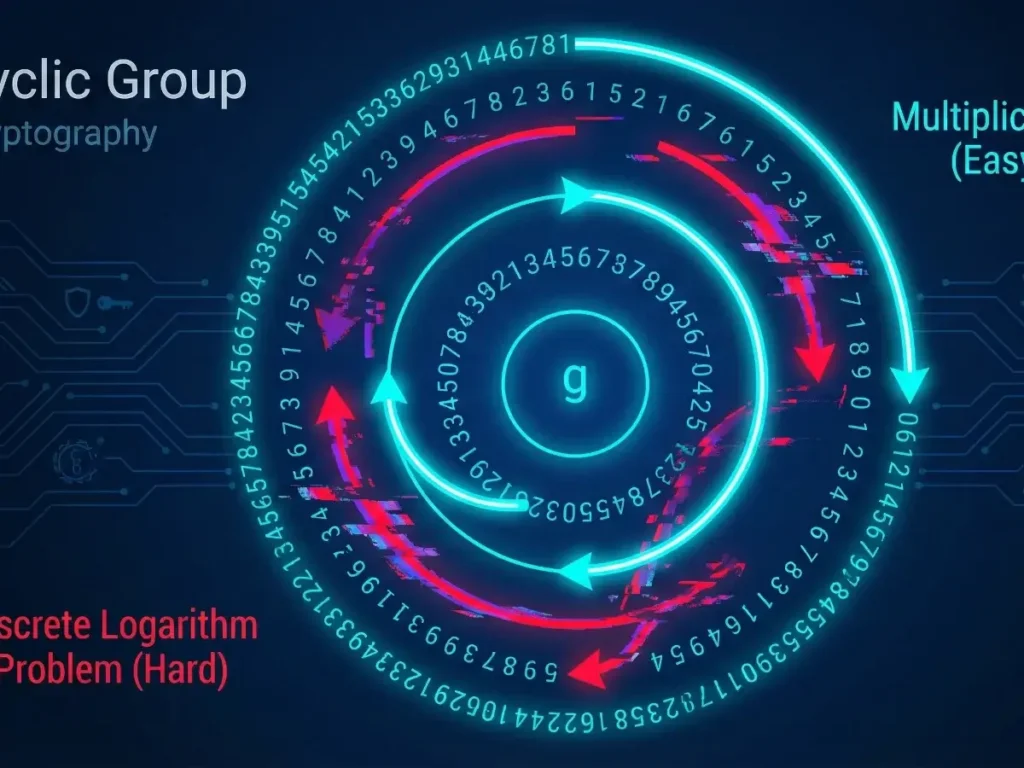
Most modern cryptography (like Diffie-Hellman and ECC) relies on a simple concept: it is easy to mix paint, but impossible to un-mix it. In mathematics, this “mixing” happens inside structures called Cyclic Groups, using a tool called a Generator. The inability to “un-mix” is known as the Discrete Logarithm Problem.
This article explains these three concepts as one cohesive system that secures the internet.
1. What is a Cyclic Group?
In cryptography, we don’t use all numbers. We use a finite set of integers modulo a prime number p. We call this set a “group.”
A group is Cyclic if you can generate every element in the set by taking a single element (let’s call it g) and multiplying it by itself repeatedly.
The “Generator” (g)
The element g is called a Generator (or primitive root). It is the “seed” that grows the entire group.
Example: Modulo 7
Let’s work with the prime p = 7. The available numbers are {1, 2, 3, 4, 5, 6}.
Let’s test if 3 is a generator.
Step 1: Powers of 3
$$ 3^1 \equiv 3 \pmod 7 $$
$$ 3^2 = 9 \equiv 2 \pmod 7 $$
$$ 3^3 = 27 \equiv 6 \pmod 7 $$
$$ 3^4 = 81 \equiv 4 \pmod 7 $$
$$ 3^5 = 243 \equiv 5 \pmod 7 $$
$$ 3^6 = 729 \equiv 1 \pmod 7 $$
Result:
The outputs are {3, 2, 6, 4, 5, 1}.
Notice that we generated every single number from 1 to 6, just in a scrambled order. This means 3 is a generator, and this group is cyclic.
2. The Discrete Logarithm Problem (DLP)
This is where the security comes from. Let’s look at the equation from the example above:
$$ 3^x \equiv 6 \pmod 7 $$
If I give you x = 3, it is easy to calculate that the result is 6. This is called Modular Exponentiation.
But if I reverse it?
“I have a generator 3 and a result 6. What was the exponent x?”
In standard arithmetic, we solve this with logarithms: \( \log_3(6) \). But in Modular Arithmetic, the numbers bounce around randomly. There is no simple pattern (like a curve) to follow.
The Formal Definition
Given a generator g, a prime modulus p, and a result h, find the integer x such that:
$$ g^x \equiv h \pmod p $$
Finding x is the Discrete Logarithm Problem. For small numbers (like 7), it’s easy. For 2048-bit numbers, it is computationally impossible for all the supercomputers on Earth combined.
3. Real World Application: Diffie-Hellman
How do we use Discrete Logarithm and Cyclic Groups to share a password over the internet without anyone seeing it? This is the Diffie-Hellman Key Exchange.
Imagine Alice and Bob want to share a secret key.
1. Public Setup
They agree on a large prime p and a generator g. Everyone knows these.
2. Private Secrets
Alice picks a secret number a.
Bob picks a secret number b.
3. The Mix (One-Way)
Alice calculates A and sends it to Bob:
$$ A = g^a \pmod p $$
Bob calculates B and sends it to Alice:
$$ B = g^b \pmod p $$
(Note: An attacker sees A and B, but cannot find a or b because of the Discrete Logarithm Problem).
4. The Shared Secret
Alice takes Bob’s public B and raises it to her secret a:
$$ s = B^a = (g^b)^a = g^{ba} $$
Bob takes Alice’s public A and raises it to his secret b:
$$ s = A^b = (g^a)^b = g^{ab} $$
Result:
They both have the same number s ($g^{ab}$), but they never sent it over the network.
4. Python Implementation
Here is a script that finds a generator and demonstrates the difficulty of the discrete log (brute force).
def power(a, b, m):
    res = 1
    a %= m
    while b > 0:
        if b % 2 == 1:
            res = (res * a) % m
        a = (a * a) % m
        b //= 2
    return res

def discrete_log_bruteforce(g, h, p):
    # Finds x such that g^x = h (mod p)
    # WARNING: Only works for small numbers!
    for x in range(p):
        if power(g, x, p) == h:
            return x
    return -1

# Example
p = 17
g = 3
target = 13
x = discrete_log_bruteforce(g, target, p)
print(f"Discrete Log: 3^{x} = {target} (mod {p})")
5. Practice Problems
Test your understanding of Discrete Logarithm and Cyclic Groups.
Problem 1: Is 2 a generator of mod 5?
Set: {1, 2, 3, 4}
$$ 2^1 = 2 $$
$$ 2^2 = 4 $$
$$ 2^3 = 8 \equiv 3 $$
$$ 2^4 = 16 \equiv 1 $$
Result: {2, 4, 3, 1}. Yes, it generated all elements.
Problem 2: Simple Discrete Log
Solve for x: $$ 3^x \equiv 4 \pmod 7 $$
Refer to the table in Section 1.
Answer: x = 4.
Conclusion
The beauty of the Discrete Logarithm and Cyclic Groups lies in their asymmetry. It is a mathematical “trapdoor” that is easy to fall through (exponentiation) but incredibly hard to climb back up (logarithm). This asymmetry is the shield that protects your messages in the digital world.
Bądź na bieżąco!
Zapisz się, aby nie przegapić nowości na Review Space.
Join Our Newsletter
No spam. Unsubscribe anytime.