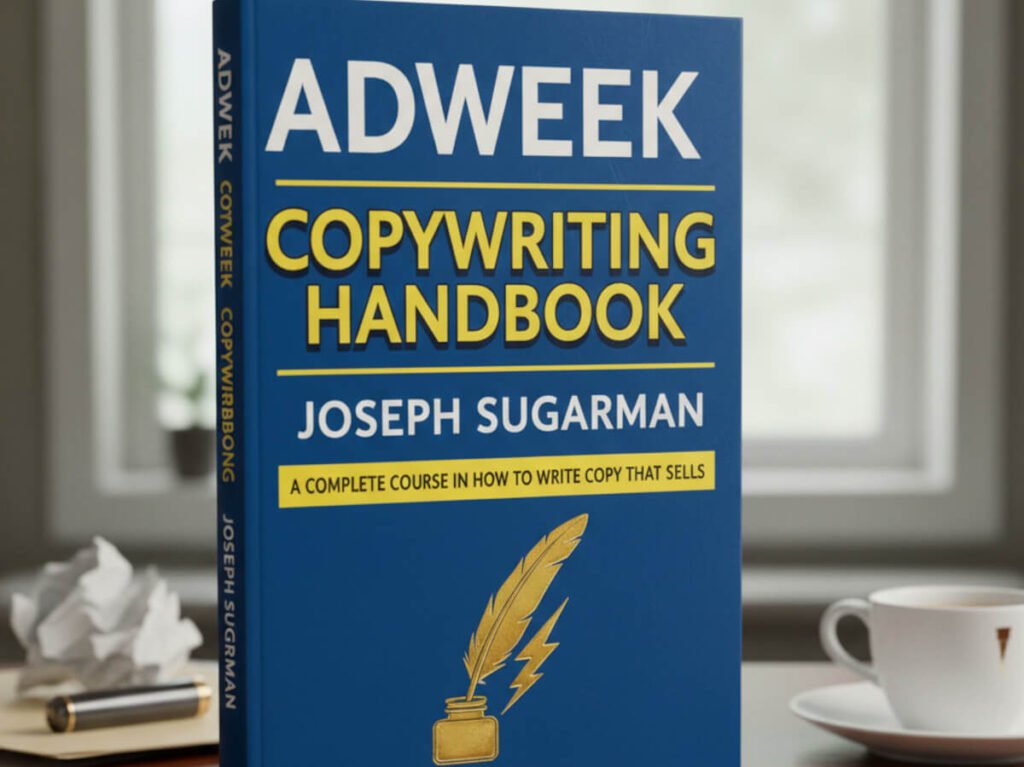
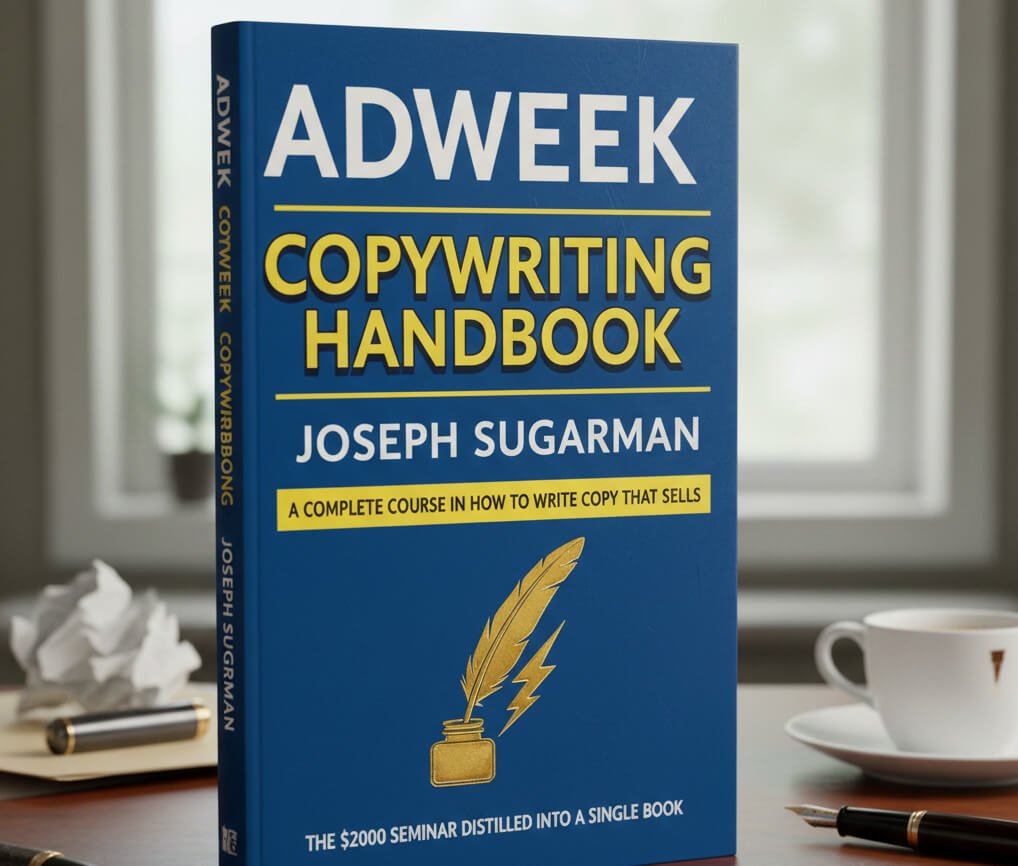
A close-up, eye-level shot of “The Adweek Copywriting Handbook” by Joseph Sugarman standing upright on a polished wooden desk. The book has a deep blue cover with the title “ADWEEK COPYWRITING HANDBOOK” prominently displayed in large white and yellow block letters. Below the author’s name, there’s a smaller yellow line that reads “A COMPLETE COURSE IN HOW TO WRITE COPY THAT SELLS.” At the bottom right, a stylized golden quill with a lightning bolt emanating from its tip is visible, along with the tagline “THE $2000 SEMINAR DISTILLED INTO A SINGLE BOOK.” In the blurred background, a window with natural light, crumpled paper, a pen, and a white teacup with a saucer and spoon are visible, suggesting a workspace. This image accompanies an Adweek Copywriting Handbook review focused on its transformative impact.
I used to think I knew how to sell. My assumption was that selling was about listing features, highlighting benefits, and maybe, if I was feeling clever, crafting a catchy slogan. However, I was wrong. My entire philosophy on persuasion was turned upside-down by a single book, and this Adweek Copywriting Handbook review will detail that profound shift.
My entire philosophy on persuasion was turned upside-down by a single book: “The Adweek Copywriting Handbook” by Joseph Sugarman. This isn’t just a book; in fact, it’s a complete masterclass, a $2,000 seminar distilled into print. Sugarman, one of America’s top copywriters, built his company JS&A Group, Inc. from his basement into a massive direct marketing powerhouse , introducing hundreds of space-age products to the American public. He did it all through the “power of his pen”.
What I learned from him wasn’t a list of “hacks” or “tricks.” Instead, it was a profound, psychological process for communicating, building trust, and leading a reader to a logical and emotional conclusion. This article is my “Story 1,” a detailed journey through the core principles of Sugarman’s handbook that fundamentally changed my approach to writing copy that sells.
Part 1: The Foundation — A New Way of Thinking
Before Sugarman, I focused on the writing. Conversely, Sugarman taught me to focus on the process that happens before a single word is written.
The Copywriter’s Dual Mindset
Sugarman’s process begins with two types of knowledge:
- General Knowledge: The best copywriters are not just writers; they are endlessly curious about everything. They read widely, have many hobbies, travel, and master various skills. Why? Because your mind is a “giant computer”. Consequently, every experience—every failure, every trip, every random fact—becomes raw material you can later combine to form a new, great idea.
- Specific Knowledge: This is the hard work. You must become an absolute expert on what you are selling. For instance, Sugarman tells a story of spending two days in a lab learning about a new digital watch, asking endless questions until he found the hook: a laser was used to seal a radioactive capsule . The headline became: “Laser Beam Digital Watch”. It sold millions. Furthermore, you must also become an expert on your customer.
The Single Most Important Goal: The First Sentence
This was my first great shock. Previously, I asked, “What is the purpose of a headline?” I would have said, “To summarize the offer” or “To state the main benefit.”
Sugarman’s answer floored me with its simplicity.
Axiom 2: All the elements in an advertisement are primarily designed to do one thing and one thing only: get you to read the first sentence of the copy.
That’s it. The headline , the subheadline , the photos , and the layout —every single graphic element has one job: to lure the reader to the very first sentence.
This naturally leads to the next revelation:
Axiom 3: The sole purpose of the first sentence in an advertisement is to get you to read the second sentence.
Ultimately, the purpose of the second sentence is to get you to read the third. This concept transforms copywriting from a “sales pitch” into the creation of a powerful momentum.
The “Slippery Slide”: The Secret to Total Engagement
If the first sentence leads to the second, and the second to the third, you are creating what Sugarman calls the “slippery slide”.
He describes it as a playground slide greased with baby oil. Once your reader starts, they should be so compelled and so engaged that they cannot stop . In effect, they slide all the way from your headline to your final call to action. This is the “reading gravity” that every copywriter must create.
How do you build this slide?
- Create the Perfect Buying Environment (Axiom 4): Your ad’s layout and the first few paragraphs must create an environment conducive to the sale. An ad for a discount product should look like a discount ad. Conversely, an ad for an expensive item should exude class and refinement.
- Grease the Slide with “Seeds of Curiosity” (Axiom 8): To keep the reader moving, you plant little “seeds of curiosity”. These are short, transitional sentences at the end of paragraphs that create intrigue and pull the reader forward.
- “But there’s more.”
- “Let me explain.”
- “Now here comes the good part.”
- “But read on.”
This concept of the slippery slide was transformative. Ultimately, it changed my goal from “informing” the reader to “captivating” them.
Part 2: The Core Philosophy — Emotion, Concepts, and Logic
Understanding the mechanics of the slippery slide was only half the battle. The next step was understanding the psychology that powers it.
Sell on Emotion, Justify with Logic
This is perhaps the most critical principle in the entire book. Sugarman lays it out as one of his three Emotion Principles:
Emotion Principle 3: You sell on emotion, but you justify a purchase with logic.
He uses the classic example of a Mercedes-Benz. Does someone buy it for the rack and pinion steering or the antilock braking system?. The answer is no. Other, cheaper cars have those features. Instead, they buy it for the emotion: the prestige, the status, the feeling of success.
But when asked why they bought it, they will never say, “Because I wanted to feel important.” Rather, they will justify their emotional decision with logic: “Oh, it’s the engineering, the safety features, the resale value”.
Therefore, your copy must do both. It must create the powerful emotional desire to buy, and then it must provide the logical justifications so the buyer can feel smart and rational about their purchase.
Never Sell a Product: Sell the Concept
This follows directly from selling on emotion. In short, people don’t buy products; they buy what the product represents.
Axiom 9: Never sell a product or service. Always sell a concept.
Sugarman argues that unless a product is so new that the product is the concept (like the first digital watches) , you are always selling something bigger.
- For example, he didn’t sell a small walkie-talkie; he sold the “Pocket CB” .
- Similarly, he didn’t sell a phone directory calculator; he sold the “Pocket Yellow Pages” and the emotional concept of pulling it out in a phone booth to the “startled eyes of those around you” .
- He even sold a smoke detector not as a piece of hardware, but as “The Nose”—a device that “sniffed the air” for you.
This concept changed my entire approach. I stopped listing features and started searching for the big idea or the “positioning” that would make the product unique .
The Power of “Yes”: Resonating with Your Reader
To build the trust needed for an emotional sale, you must get your reader in a state of agreement.
Axiom 5: Get the reader to say yes and harmonize with your accurate and truthful statements while reading your copy.
Your copy must be a series of statements that the reader instinctively agrees with, for example, “Losing weight is not easy” or “We all take our food supply for granted”.
The moment a reader thinks, “No, I don’t believe that,” or “That’s not true,” the harmony is broken, and the sale is lost. This is why you must get them nodding “yes” all the way down the slippery slide, so that when you ask for the order, “yes” is the most natural response .
Part 3: The Writer’s Process — From Idea to Polished Gem
Sugarman also demystified the act of writing itself.
The Incubation Process: How to Let Your Subconscious Work
Great copy isn’t “written”; it’s assembled by the subconscious mind.
Axiom 10: The incubation process is the power of your subconscious mind to use all your knowledge and experiences to solve a specific problem….
His method is simple:
- Gather all your general and specific knowledge about the product and customer.
- Think about it deeply. Jot down notes .
- Stop.
- Go do something else. Something pleasurable. A walk, a movie, lunch with a friend. Do not think about the project .
During this “incubation period,” your subconscious is working, processing all that data and running “millions of permutations” to find the best solution. Then, “Eureka!”—the big idea will flash into your mind, often when you least expect it .
The Editing Process: The Real Secret to Greatness
This was the most liberating concept for me. Previously, I always froze, trying to make my first draft perfect. Thankfully, Sugarman shatters this myth.
He states that his own first drafts are often “terrible” —for instance, “Poor grammar, atrocious spelling and disjointed sentence structure”. The magic, he explains, is not in the writing; it’s in the editing.
Axiom 14: In the editing process, you refine your copy to express exactly what you want to express with the fewest words.
He provides concrete steps:
- Look for “that” words: Phrases like “you know that…” can often be eliminated .
- Combine sentences: To make them flow better and save words.
- Edit for rhythm: Vary the length of your sentences so they don’t sound monotonous .
- Eliminate unnecessary words: Cut, cut, and cut again until only the essence remains.
To illustrate, he compares the first draft to giving birth and editing to “raising the child”. This mental model freed me to “dump” all my emotional, raw ideas onto the page, knowing the real work would come later.
Part 4: The Toolkit — 31 Psychological Triggers That Compel Action
Section Two of the book is the advanced masterclass. It lists 10 graphic elements, 23 copy elements, and 31 psychological triggers . The 31 triggers are the true “secrets” to motivation. While I cannot detail all 31, here are the ones that had the biggest impact on me.
1. Honesty, Integrity, and Credibility
This is arguably the most important trigger. Sugarman argues that consumers are “very smart” and can sense dishonesty. Therefore, the most effective way to build trust is to be brutally honest—even about your product’s flaws . By pointing out the negatives yourself, you build immense credibility, so that when you get to the positives, the reader believes you implicitly.
2. Feeling of Involvement or Ownership
You must get the prospect to mentally “own” the product before they buy it. For example, he tells the story of a TV salesman who knew he had a 50% chance of a sale if a customer turned the knobs on a TV . In print, however, you do this with words: “Hold the Litronix 2000 in your hand. See how easily the keys snap to the touch”. In short, you make them imagine the experience.
3. Value, Justification, and Greed
This ties back to the emotion/logic principle. First, you must establish Value. Second, you must Justify the Purchase by giving the reader the logical reasons they need to complete the emotional purchase. And finally, don’t be afraid to appeal to Greed. A bargain is a “very strong motivating factor”.
4. Establish Authority
People want to buy from experts. For instance, Sugarman famously branded JS&A as “America’s largest single source of space-age products”. This single phrase established him as the leading authority, building confidence and trust.
5. Satisfaction Conviction
This is more powerful than a simple guarantee. Specifically, a satisfaction conviction is an offer so strong that the customer thinks, “They must really believe in their product” or “How can they do it?” .
- Example: For his BluBlocker sunglasses, he offered a lifetime return policy: “If you’re unhappy… I’ll let you return them anytime you want” .
- Example: For his Consumers Hero club, he offered: “Send us just your membership card and we’ll fully refund your five dollars plus send you interest on your money”. This one change doubled the ad’s response rate.
6. Curiosity
In mail order, the prospect can’t touch the product. As a result, this makes curiosity one of the strongest motivators. Sugarman brilliantly used this for BluBlockers. In his TV ads, he showed people’s reactions to putting the glasses on , but he never showed the viewer the world through the lens . The only way to satisfy your curiosity was to buy a pair. 8 million pairs were sold.
7. Simplicity
Keep your offer simple. Sugarman proved this with a famous A/B split test for the Swiss Army watch .
- Ad A, for example, offered all nine models (three styles, three colors) .
- In contrast, Ad B offered only one model: the men’s black watch.
The ad with one choice outpulled the ad with nine choices by a 3-to-1 ratio. Offering too many choices causes confusion and inaction.
8. Storytelling
People are “primed for stories ever since we were very young”. Consequently, a story creates an emotional bond and keeps a reader riveted. For example, the entire “Vision Breakthrough” ad for BluBlockers is a story of how his friend Len called him about a pair of sunglasses . This is far more engaging than a simple list of features.
9. Linking
This is the technique of relating what your consumer already knows to the new product you’re selling. This “bridge” makes the new concept easy to understand . A great example is his ad for a smoke detector, which he called “The Nose”. In it, he linked the electronic device to a familiar body part, and the concept instantly made sense.
10. Fear and a Sense of Urgency
Fear is a “great motivator”. This can be fear of crime (selling a burglar alarm) , fear of aging (selling face cream) , or fear of loss. This, in turn, leads to Sense of Urgency. You must give the prospect a reason to “buy now” , because if they “think about it,” they will almost certainly not buy.
Part 5: The Golden Rule — Sell the “Cure,” Not the “Prevention”
This concept, outlined in Chapter 20, was another “aha!” moment for me.
Axiom 15: Selling a cure is a lot easier than selling a preventive, unless the preventive is perceived as a cure or the curative aspects of the preventive are emphasized.
After all, it’s human nature to believe a bad thing won’t happen to us.
- Prevention (Hard to Sell): A pill to prevent cancer.
- Cure (Easy to Sell): A pill to cure cancer after you have it.
A burglar alarm is a preventive item, which is a tough sell… until your neighbor gets robbed. Then, suddenly, buying that alarm feels like a cure for your new-found fear. Therefore, when marketing a product, you must find the “cure” angle. For his fuel-conditioning pill, Sugarman didn’t emphasize that it prevents engine problems; he emphasized that it cures engine knock and saves you money on gas .
Part 6: Proof in Practice — Analyzing the Classics
Section Three of the book proves all these points by analyzing real-world ads.
Case Study 1: “The Lazy Man’s Way to Riches” (Joe Karbo)
This classic ad by Joe Karbo sold 3 million books, and it’s a perfect execution of Sugarman’s principles:
- Slippery Slide: It starts with short, simple sentences: “I used to work hard. The 18-hour days. The 7-day weeks”.
- Honesty & Curiosity: It’s disarmingly honest. “I’m going to ask you to send me 10 dollars for something that’ll cost me no more than 50 cents” . This honesty builds trust and massive curiosity.
- Satisfaction Conviction: The offer is irresistible. “I won’t even cash your check or money order for 31 days”. This was a novel approach that showed supreme confidence.
- Resonating (Broad Appeal): Karbo masterfully identifies with everyone. “I’m a high school graduate”. “When I started out, I was so deep in debt…”. He notes a 70-year-old woman and a widow use his methods . He makes everyone feel like they can do it.
Case Study 2: “A Fluke of Nature” (Frank Schultz)
This ad for grapefruit was written by Frank Schultz, a farmer who attended Sugarman’s seminar . After failing with ad agencies, he wrote this ad himself and it became a massive, long-running success .
- Authority & Integrity: The ad starts, “I’m a farmer”. This simple statement immediately establishes honesty and credibility .
- Storytelling: The copy tells a “fairy tale” of how the “Royal Ruby Red” grapefruit was discovered by a doctor on a single, magical branch .
- Rarity & Exclusivity: It builds incredible value by positioning the fruit as rare. “Not one man in a thousand has ever tasted this grapefruit”. “Only 4 to 5 percent of the entire crop will qualify”.
- Technical Explanation (for a Simple Product): He makes a simple product complex. He talks about checking for “natural sugar” and “low acid balance”. He mentions using a “picking ring” and rejecting fruit with “wind scarring” or “sheep nose” . This makes him the ultimate expert.
- Satisfaction Conviction: The offer is pure genius. He sends a box of 16-20 grapefruit, asks you to try just four , and if you’re not happy, you can “return the unused fruit (at my expense)”. It’s a risk-free sample that conveys total confidence.
Case Study 3: “Magic Baloney” (JS&A)
This is Sugarman’s own ad for a thermostat and a masterclass in raising and resolving objections.
- The Hook (Brutal Honesty): The ad starts by hating the product. Headline: “Magic Baloney”. Caption: “It had no digital readout, an ugly case and a stupid name. It almost made us sick” . Copy: “we’re going to tear it apart. Unmercifully” . This instantly grabs you and builds curiosity and trust.
- Resolving the #1 Objection FIRST: He knows the biggest objection to a thermostat is installation. So, the first good thing he “discovers” is how easy it is to install .
- The Slippery Slide of Discovery: After resolving the main objection, the copy “discovers” one incredible feature after another, building momentum until the “real loser” is revealed to be “the most… advanced… thermostat ever developed”.
Part 7: Beyond Print — Applying the Principles Everywhere
The final section of the book explains how these core principles are universal. What changed for me was realizing that all media are just different venues for the same human psychology.
- For Catalogs: The cover acts as the headline. Meanwhile, the president’s letter in the front is the “personal communication” that builds trust.
- For Direct Mail: The envelope copy serves as the headline. Moreover, the letter must be deeply personal (“I” not “we”).
- For Radio: This medium is “theater of the mind”. You must be personal, have one “core message” , and feature an easy-to-remember call to action (like 1-800-FLOWERS).
- For Television: A short-form spot (30-120 seconds) must be simple, high-value, and urgent . Conversely, an infomercial (long-form) is just like a long print ad, giving you 28.5 minutes to build a case, tell a story, and provide justification.
- For the Internet: This is the ultimate medium for Sugarman’s principles.
- E-mail: The subject line is the new headline . The message, therefore, must be personal, brief, and build a relationship rather than just sell.
- Long Sales Letter: This is the new “long-form ad”. It can be 32 pages long, but it uses the same slippery slide. It’s even more powerful because it can include video testimonials and “Buy Now” buttons for instant action.
My Final Thoughts
“The Adweek Copywriting Handbook” did more than teach me to write; it revealed that copywriting is not the act of arranging words, but the art of understanding human psychology. I learned it’s about being an expert, being honest, telling a compelling story, and leading someone on an emotional journey. Furthermore, it’s about building a slippery slide of curiosity and trust, justifying logic with emotion, and understanding that every product has a “cure” at its core.
Joseph Sugarman gave away the keys to the kingdom. He showed us how to create “the goose that lays the golden egg”. After reading this book, I finally understood that I’m not just a writer. I am, in fact, an architect of persuasion. And for that, this book will always be my “Story 1.”
Bądź na bieżąco!
Zapisz się, aby nie przegapić nowości na Review Space.
Join Our Newsletter
No spam. Unsubscribe anytime.