Welcome to Review Space
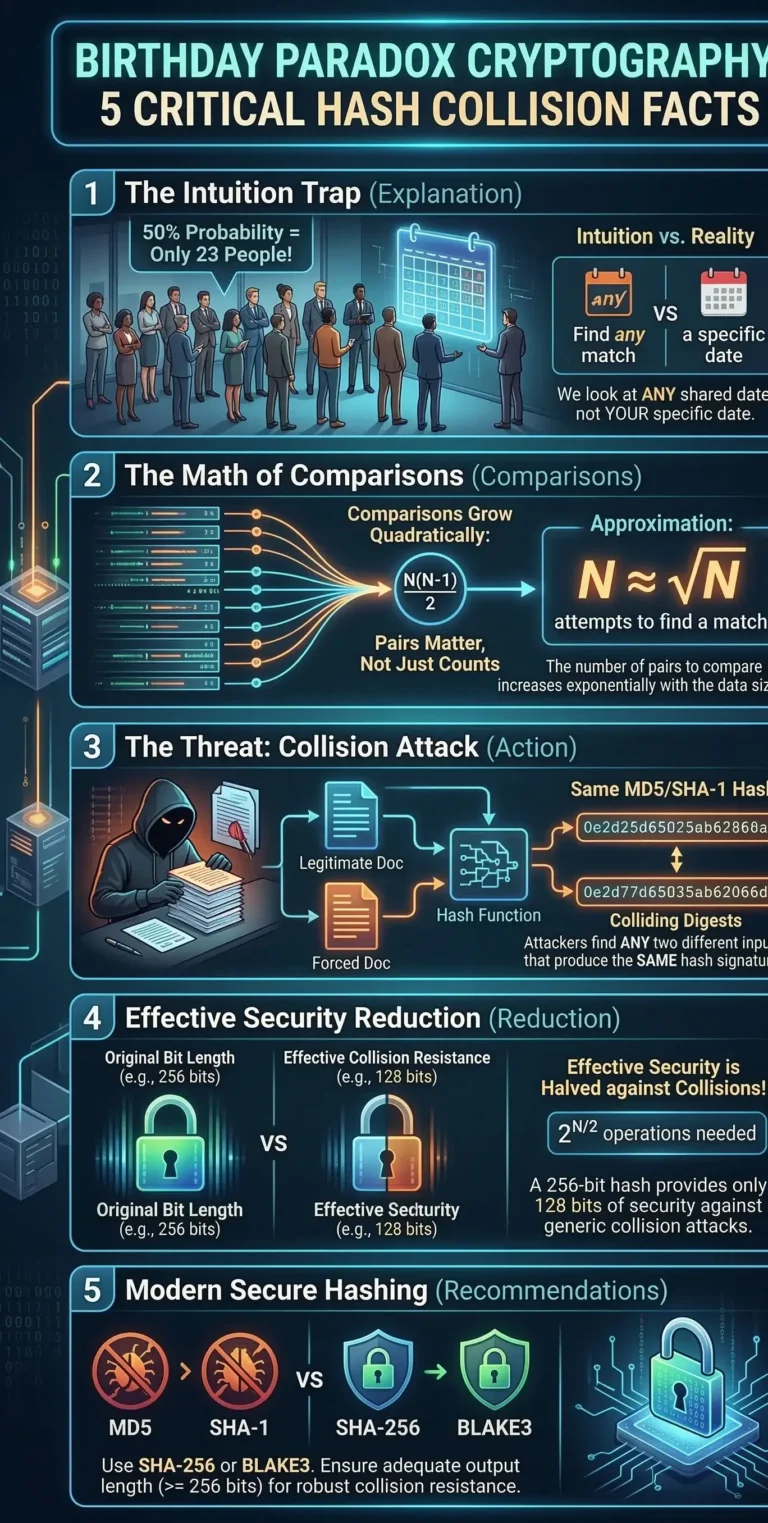
A detailed infographic explaining birthday paradox cryptography and hash collision probability. It visually breaks down a complete birthday attack explanation, showing how 23 people create a 50% match chance, the mathematics of an MD5 collision, and why effective cryptographic security is halved.
Cryptography Mar 12 7 min

Birthday Paradox Cryptography: 5 Critical Hash Collision Facts

Birthday paradox cryptography is the absolute mathematical foundation for understanding how digital signatures, blockchain ledgers, and password storage…
Read More →
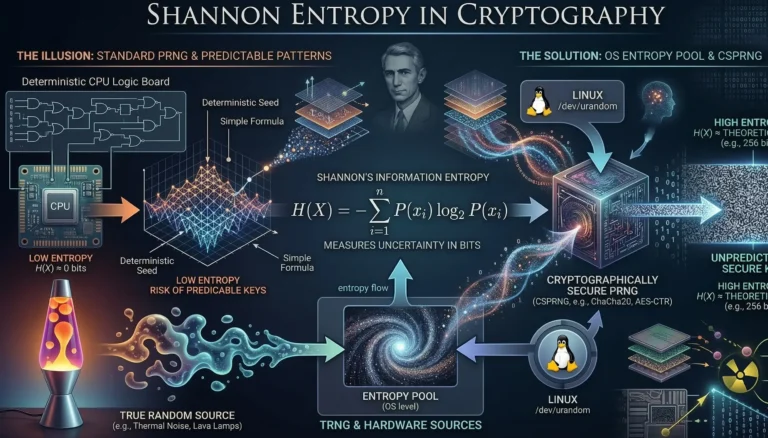
A detailed architectural infographic explaining Shannon entropy in cryptography. The left side illustrates the deterministic flaw of standard PRNGs leading to predictable keys with low entropy. The center and right sides demonstrate the secure solution: combining true random sources into an OS entropy pool. This pool feeds Linux /dev/urandom and powers a Cryptographically Secure Pseudo-Random Number Generator (CSPRNG) to create unpredictable, high-entropy cryptographic keys.
Cryptography Mar 12 7 min

Shannon Entropy in Cryptography: 5 Critical Rules for Secure Keys

Understanding Shannon entropy in cryptography is not just an academic exercise; it is the absolute foundation of modern…
Read More →
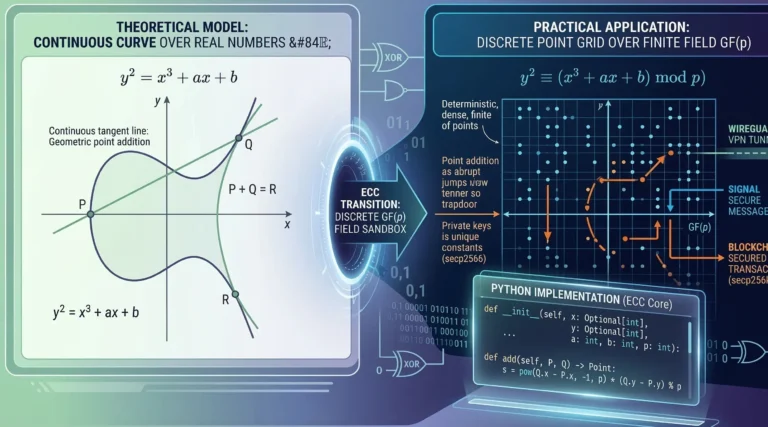
Detailed educational infographic comparing the theoretical continuous mathematics of elliptic curves with their practical application in discrete elliptic curve cryptography (ECC) over finite fields. The left panel shows a continuous curve ($y^2 = x^3 + ax + b$) demonstrating geometric point addition. A transition portal leads to the right panel illustrating a discrete point grid over a finite field GF(p) with modulo p arithmetic, explaining how points hop deterministically. This discrete property creates a secure 'trapdoor' function used in blockchain security (secp256k1), WireGuard VPN tunnels, and Signal messaging. A foreground element features a Python implementation (ECC Core) with code examples for initialization and point addition, showcasing the crucial use of modular inverse calculations.
Cryptography Mar 10 9 min

7 Brilliant Secrets of Elliptic Curve Cryptography & ECC

Finite Fields in Elliptic Curve Cryptography (ECC): From Theory to Practice Modern digital security is undergoing a fundamental…
Read More →
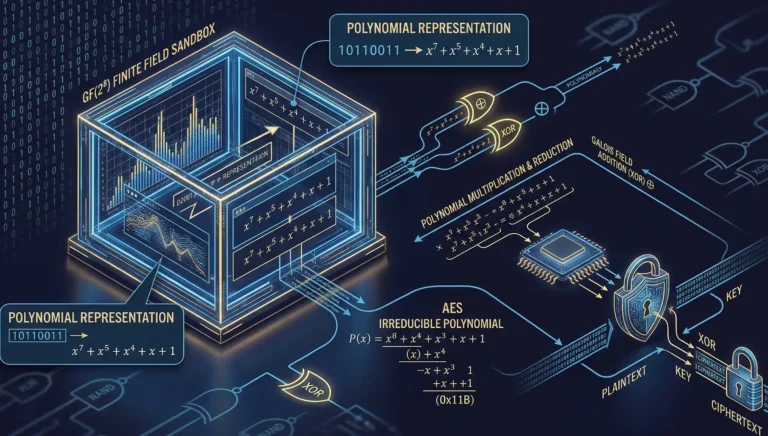
A high-tech diagram illustrating operations in finite fields and polynomial arithmetic. It visually explains how binary bytes are converted into polynomials, showing that addition in Galois field operates as hardware logic gates for secure XOR encryption.
Cryptography Mar 10 11 min

7 Brilliant Secrets of Operations in Finite Fields & XOR Encryption

Finite Field Arithmetic: How Computers Add and Multiply Bytes At the core of every secure digital communication—whether you…
Read More →
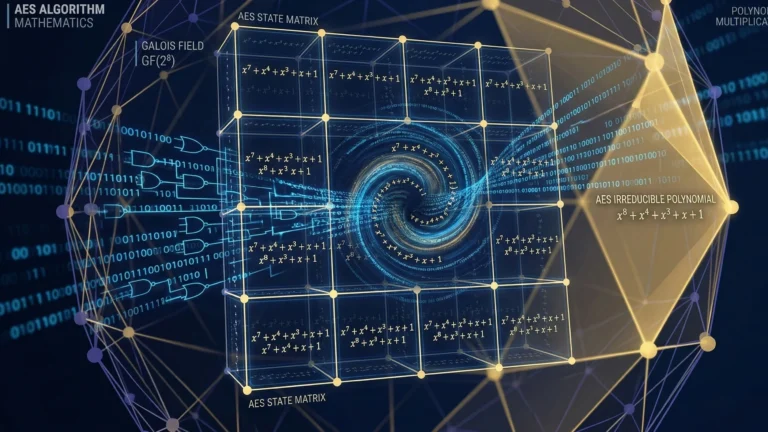
A high-tech 3D visualization explaining how AES works, featuring the AES State Matrix and AES algorithm mathematics with polynomial equations in Galois fields (GF(2^8)) for cryptography.
Cryptography Mar 12 12 min

How AES Works: 5 Brilliant Secrets of Algorithm Mathematics

How AES Works: The Brilliant AES Algorithm Mathematics Explained If you have ever connected to a virtual private…
Read More →
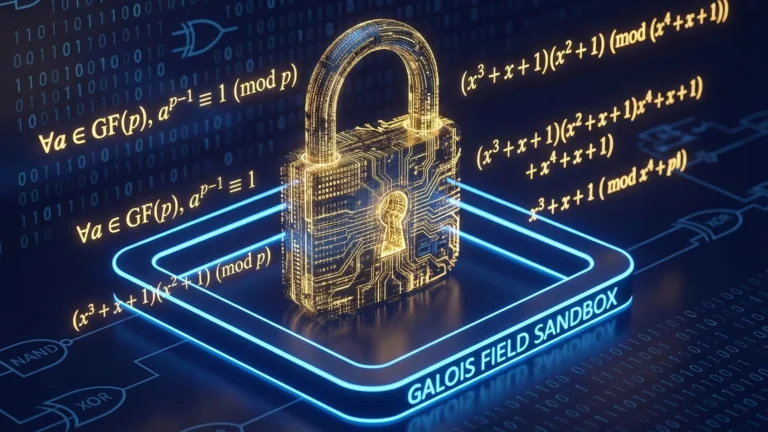
igh-tech conceptual art of a cryptographic lock surrounded by floating math formulas representing Galois fields. A geometric, blue light platform below is labeled 'Finite Field Sandbox', visualizing how modular arithmetic and polynomials contain data without loss for secure AES encryption.
Cryptography Mar 8 10 min

Galois Fields Explained: 5 Amazing Secrets for Cryptography

Galois Fields Explained: 5 Amazing Secrets of Finite Fields in Cryptography If you write code for a living,…
Read More →
Privacy
We respect your privacy. We use cookies for analytics and marketing purposes to improve your experience. Read more.
Preferences

Data Preferences

×

Strictly Necessary

Required for the site to function properly.

Analytics & Marketing

Google Analytics 4, Meta (Facebook) Pixel.