Introduction: The Economics of the Digital Shelf
In the pre-digital era, starting a retail business required significant capital: rent for a physical storefront, inventory warehousing, and local advertising. In economic terms, the Barrier to Entry was high. Today, that barrier has collapsed. The internet has democratized commerce, moving us closer to the economic ideal of Perfect Competition—a market structure where many firms sell identical or similar products, and entry/exit is frictionless.
However, “easy to start” does not mean “easy to succeed.” While the barriers to entry are low, the Noise-to-Signal ratio is deafening. To succeed in 2025, you cannot just be a shopkeeper; you must be a strategist.
This guide is not merely a list of software. It is a strategic analysis of the modern e-commerce landscape. We will review the major platforms through the lens of Total Cost of Ownership (TCO) and Scalability, and then provide a step-by-step blueprint to monetizing your digital presence using fundamental economic principles.
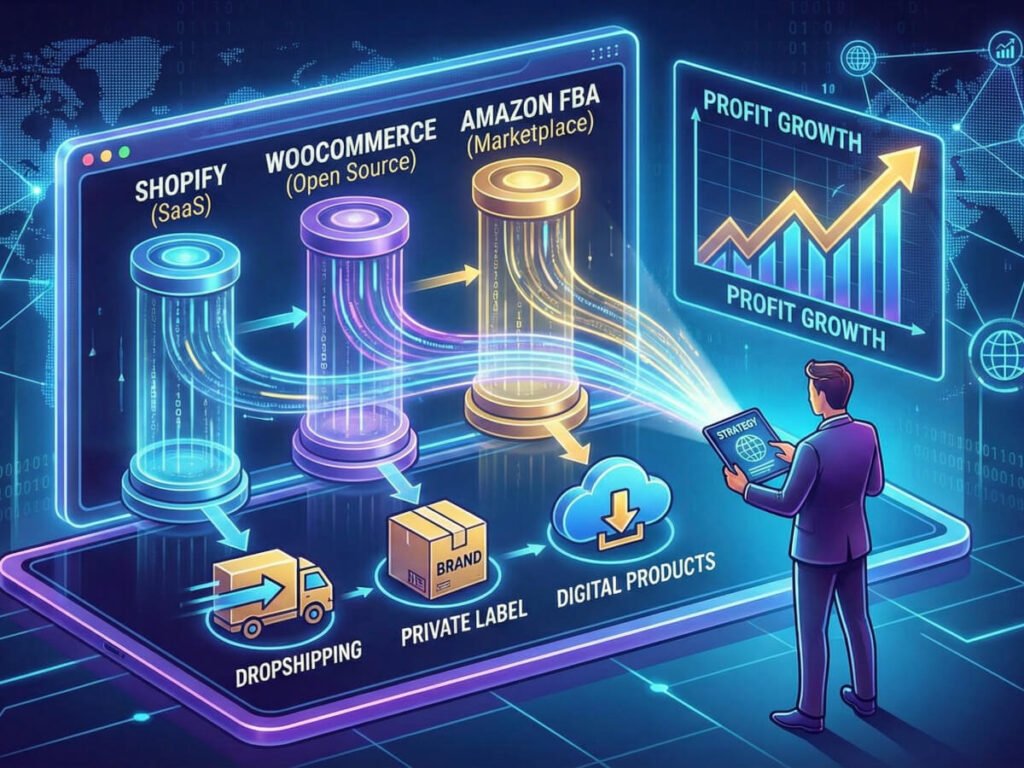
Part I: The Great Platform Debate (SaaS vs. Open Source)
In this review of e-commerce platforms, we explore how the digital era has transformed retail. In the pre-digital era, starting a business required significant capital. Today, the barrier to entry has collapsed, moving us closer to the economic ideal of Perfect Competition.
1. Hosted Platforms (SaaS – Software as a Service)
Examples: Shopify, BigCommerce, Wix.
In this model, you pay a monthly “rent” to a landlord who handles the hosting, security, and infrastructure.
- The Economic Trade-off: You trade Control for Convenience. You reduce your technical “transaction costs” (time spent fixing bugs), but you incur higher variable costs (monthly fees + transaction fees).
- Best For: Entrepreneurs who want to focus 100% on marketing and 0% on code.
2. Self-Hosted Platforms (Open Source)
Examples: WooCommerce (WordPress), Magento, PrestaShop.
Here, you own the software. You rent the server (hosting), but the house (the code) is yours.
- The Economic Trade-off: You trade Convenience for Control and Equity. Your startup costs might be higher in time (learning curve), but your long-term marginal costs are lower because you don’t pay transaction fees to the platform.
- Best For: Those who want full customization, SEO control, and asset ownership.
Part II: Detailed Review of Top E-Commerce Platforms
Let’s analyze the market leaders, evaluating them on pricing, flexibility, and profit potential.
1. Shopify: The Giant of Efficiency
Shopify is the iPhone of e-commerce: sleek, expensive, and it just works.
- The Mechanics: It is a fully hosted solution. You pay a monthly fee (starting around $29/month) plus a percentage of every sale unless you use their payment gateway.
- Pros:
- Speed to Market: You can launch a store in 2 hours.
- App Ecosystem: Thousands of plugins for dropshipping (DSers), email marketing (Klaviyo), and reviews.
- Reliability: 99.9% uptime. You don’t worry about servers crashing on Black Friday.
- Cons:
- The “Rent” Trap: If you stop paying, your business disappears instantly.
- SEO Limitations: You cannot modify the URL structure or
robots.txtfile easily.
- Economic Verdict: High Operational Expenditure (OpEx), low Capital Expenditure (CapEx). Best for rapid scaling.
2. WooCommerce: The King of Flexibility
WooCommerce is a plugin that turns a WordPress site into a store. It powers over 25% of all online stores.
- The Mechanics: Free open-source software. You pay for hosting ($5-$20/month), domain, and premium plugins if needed.
- Pros:
- Total Ownership: You own your data. No one can shut you down.
- SEO Superiority: WordPress is the gold standard for content marketing and SEO.
- Cost Efficiency: No transaction fees. Perfect for arbitrage and high-volume/low-margin models.
- Cons:
- Technical Debt: You are responsible for security updates and backups.
- Plugin Conflicts: An update to one plugin can break another.
- Economic Verdict: High CapEx (time/setup), low OpEx. The best choice for content-driven commerce (reviews, blogs).
3. Amazon FBA: The Marketplace Leviathan
Selling on Amazon is different from having your own store. You are renting shelf space in the world’s biggest mall.
- The Mechanics: You send your inventory to Amazon’s warehouse. They handle storage, packing, and shipping (Fulfillment by Amazon).
- Pros:
- Network Effects: You get access to millions of Prime members with credit cards on file.
- Trust: Consumers trust Amazon’s return policy more than an unknown website.
- Cons:
- Cannibalization: Amazon collects data on your sales. If your product succeeds, they may launch a generic version (Amazon Basics) and undercut you.
- Fees: Referral fees and storage fees can eat 30-40% of your margin.
- Economic Verdict: High volume, low margin. You are a supplier, not a brand owner.
Part III: Strategic Models for Monetization
Once you have chosen a platform, how do you actually make money? We apply the Risk vs. Reward theory here.
Strategy A: Dropshipping (The Low Risk / High Competition Model)
You act as a middleman. You list a product on your site; when a customer buys it, your supplier ships it directly to them. you never touch the inventory.
- Economic Concept: Just-in-Time (JIT) inventory management. You eliminate warehousing costs.
- The Reality Check: Margins are thin (15-20%). Success depends entirely on Customer Acquisition Cost (CAC). If your ads cost more than your profit, you lose.
Strategy B: Private Labeling (The Brand Building Model)
You find a generic product (e.g., a water bottle) from a manufacturer (Alibaba), improve it slightly, put your logo on it, and sell it as a brand.
- Economic Concept: Product Differentiation. By adding a brand, you escape “perfect competition” and create a “monopolistic competition” where you can charge a premium price.
- The Reality Check: Requires upfront capital for inventory (MOQ – Minimum Order Quantity).
Strategy C: Digital Products & Arbitrage (The Zero Marginal Cost Model)
Selling eBooks, courses, software templates, or using traffic arbitrage (buying cheap traffic and monetizing with ads/affiliate offers).
- Economic Concept: Zero Marginal Cost. It costs the same to produce 1 copy of a PDF as it does to produce 1,000,000 copies.
- The Reality Check: High initial effort in creation, passive income later.
Part IV: Step-by-Step Guide to Launching (From Zero to Profit)
This 6-step roadmap integrates technical setup with marketing psychology.
Step 1: Niche Selection via the “Long Tail” Theory
Do not start a general store (e.g., “John’s Electronics”). You cannot compete with Amazon on price. Instead, use the Long Tail Theory. Focus on a specific, underserved micro-niche.
- Bad Niche: “Dog food.”
- Good Niche: “Organic grain-free treats for diabetic Pugs.”
- Action: Use Google Trends and Ahrefs/SEMrush to find keywords with decent volume but low difficulty.
Step 2: Infrastructure Setup (The “Review Space” Approach)
For maximum flexibility and affiliate potential, a WordPress + WooCommerce setup is recommended.
- Domain & Hosting: Buy a
.comor.shopdomain. Use a fast host (SiteGround or Hostinger). - CMS Installation: Install WordPress.
- Design: Use a page builder like Elementor or Divi. Why? Because visual perception correlates with trust. A broken layout increases bounce rate.
- Essential Plugins:
- SEO: RankMath or Yoast.
- Speed: WP Rocket or LiteSpeed Cache.
- Security: Wordfence.
Step 3: The Content & Copywriting Strategy
You need to persuade visitors. Use AIDA (Attention, Interest, Desire, Action).
- Product Descriptions: Don’t use the supplier’s text. Focus on benefits, not features.
- Feature: “5000mAh battery.”
- Benefit: “Lasts for 2 days on a single charge, so you’re never stranded.”
- Social Proof: Import reviews. Humans follow the herd behavior.
Step 4: Traffic Generation (Arbitrage & SEO)
A store without traffic is a billboard in the desert.
- SEO (The Long Game): Write blog posts related to your niche (“Top 10 toys for Pugs”). Use the “Hub and Spoke” model—one main product page linked to by many informational articles.
- Paid Ads (The Short Game):
- Google Shopping: High intent. People searching here are ready to buy.
- Facebook/TikTok Ads: disruptive marketing. Good for “impulse buy” products.
- Traffic Arbitrage: Buy cheap clicks from native ad networks (like Taboola) or social media, drive them to a content-heavy page on your site with high-paying affiliate links or AdSense blocks.
Step 5: Analyzing the Unit Economics
You must know your numbers to survive.
- CAC (Customer Acquisition Cost): How much you spend on ads to get 1 sale.
- AOV (Average Order Value): How much the customer spends.
- LTV (Lifetime Value): How much the customer spends over years.
- The Golden Rule:
LTV > CAC. If your LTV is $50 and your CAC is $60, you are bleeding money. - Strategy: Use “Upsells” (Would you like fries with that?) and “Cross-sells” at checkout to increase AOV without increasing CAC.
Step 6: Optimization and Automation
Once you have sales, stop working in the business and start working on the business.
- Email Marketing: Collect emails. Email has the highest ROI of any channel. Send abandoned cart reminders.
- Outsourcing: Use Virtual Assistants (VAs) for customer support and order fulfillment.
Part V: The Psychology of Pricing
Economic theory suggests that price is determined by supply and demand. Behavioral economics suggests price is determined by perception.
- Anchoring: Display the “Original Price” of $100 crossed out, next to the “Sale Price” of $50. The $100 is the anchor; it makes $50 feel like a steal, even if the product is only worth $50.
- The Decoy Effect: If you sell a software subscription:
- Plan A: $10/month (Basic)
- Plan B: $30/month (Pro – The one you want to sell)
- Add a Decoy: Plan C: $50/month (Pro + 1 small feature). Plan C makes Plan B look like incredible value.
- Charm Pricing: Prices ending in .99 or .95 ($19.99 vs $20.00). This is known as the “left-digit effect.” Our brains encode the number before we finish reading it.
Conclusion: The Era of the Agile Entrepreneur
The era of “build it and they will come” is over. The internet is saturated. However, the era of the Agile Entrepreneur has just begun.
The winners in the next decade of e-commerce will not be the ones with the biggest budgets. They will be the ones who understand the intersection of Technology (choosing the right platform like WooCommerce or Shopify), Psychology (Social Engineering in marketing, persuasive copy), and Economics (managing margins and LTV).
Starting an online business is an exercise in problem-solving. You are solving a problem for a customer (via your product) and solving a problem for yourself (financial independence).
Your Next Move: Don’t get stuck in “Analysis Paralysis.” Pick a niche today. Install WordPress or sign up for Shopify tomorrow. Launch a “Minimum Viable Product” (MVP) next week. The market rewards action, not intention.
Bądź na bieżąco!
Zapisz się, aby nie przegapić nowości na Review Space.
Join Our Newsletter
No spam. Unsubscribe anytime.