In the early days of the internet, online scams were almost comical in their simplicity. We all remember the emails from a “Nigerian Prince” promising millions of dollars in exchange for a small processing fee. The grammar was poor, the premise was absurd, and the red flags were neon-bright.
Today, the landscape has shifted dramatically. Cybercrime has evolved into a trillion-dollar global industry. Modern scammers are not just lone hackers in hoodies; they operate like multinational corporations with HR departments, scripts, and advanced technical support. They leverage Social Engineering, Artificial Intelligence, and deep psychological manipulation to bypass our defenses.
This guide goes beyond the basics. We will dissect the anatomy of modern scams, explore the psychology behind why they work, and provide you with the cybersecurity toolkit needed to survive the digital minefield.
Part I: Hacking the Human (The Psychology of Social Engineering)
Before understanding the code, you must understand the mind. The most sophisticated vulnerability in any security system is not the software—it is the user. This concept is known as Social Engineering.
Scammers know that hacking a firewall takes days of effort and high-level skill. Hacking a human takes a 15-minute phone call. To do this, they exploit specific cognitive biases:
1. The Urgency Principle
Scammers engineer scenarios that induce panic. When the human brain is in a state of “fight or flight,” the prefrontal cortex—the part responsible for logic and critical thinking—shuts down.
- Example: “Your bank account has been compromised. You must transfer funds to a secure vault immediately, or you will lose everything.”
- The Goal: To make you act before you think.
2. The Authority Bias
We are conditioned from childhood to obey authority figures. Scammers impersonate police officers, IRS/HMRC agents, or bank executives.
- Example: The “CEO Fraud” (Business Email Compromise). An employee receives an email from their “CEO” demanding an urgent wire transfer for a “secret acquisition.” Because it comes from the boss, the employee bypasses security protocols.
3. The Scarcity Heuristic
Fear Of Missing Out (FOMO) is a powerful driver. This is prevalent in investment and shopping scams.
- Example: “Only 3 spots left for this guaranteed 500% ROI crypto investment.”
Part II: Anatomy of Modern Scams (Real-World Case Studies)
Let’s analyze the most dangerous scams currently circulating, breaking down their mechanics.
1. The “Pig Butchering” Scam (Sha Zhu Pan)
Severity: Critical Target: Cryptocurrency Investors / Daters
This is a long-con scam that originated in Asia and has gone global. It fuses romance scams with investment fraud.
- The Setup: You receive a text from a wrong number, or match with an attractive, successful person on a dating app. They don’t ask for money immediately. Instead, they spend weeks or months building a genuine emotional connection (fattening the pig).
- The Hook: Casual conversation turns to finance. The scammer shares screenshots of their massive crypto gains on a specific trading platform. They offer to teach you.
- The Trap: You are directed to a fake website that looks identical to a legitimate exchange (like Binance or Coinbase). You invest a small amount ($500). The scammer manipulates the backend to show you made a profit. They even let you withdraw money once to build trust.
- The Slaughter: Convinced it works, you invest your life savings. Suddenly, the platform freezes. Support claims you must pay a “tax” to withdraw. You pay, but the money never comes. The site vanishes.
Key Takeaway: If an online romantic interest starts giving you investment advice, it is a scam. 100% of the time.
2. The Triangulation Fraud
Severity: Moderate to High Target: E-commerce Shoppers
This scam is clever because the victim actually receives the item they ordered, so they don’t realize they’ve been scammed until much later.
- Step 1: A scammer sets up a fake store (or an eBay listing) selling a high-value item (e.g., a Lego set or coffee machine) at a significant discount.
- Step 2: You buy the item for $200 (Market value $300). You pay the scammer.
- Step 3: The scammer uses a stolen credit card to buy that same item from a legitimate retailer (like Amazon) for $300 and ships it to your house.
- The Result: You get the product. The scammer keeps your $200 clean money. The owner of the stolen credit card eventually files a chargeback. The police investigate the delivery address—which is yours.
3. Quishing (QR Code Phishing)
Severity: High Target: Drivers / Office Workers
People are trained to check email URLs, but they blindly trust QR codes.
- The Scenario: Scammers place fake parking ticket citations on cars with a QR code for “quick payment.” Or, they stick a fake QR code over a real one on a parking meter or restaurant menu.
- The Attack: The QR code directs the user to a phishing site that steals credit card details or installs malware on the smartphone. Because the URL is hidden behind the code, visual verification is impossible before scanning.
Part III: Technical Red Flags (Cybersecurity Analysis)
You don’t need to be a coder to spot technical anomalies. Here is what to look for in the digital headers and footers.
1. Typosquatting and Homoglyphs
Scammers register domains that look almost identical to real ones.
- Legit:
paypal.com - Scam:
paypaI.com(Capital ‘i’ looks like lowercase ‘L’) - Scam:
rnicrosoft.com(‘r’ and ‘n’ combined look like ‘m’)
Pro Tip: Always hover your mouse over a link (without clicking) to preview the actual destination URL. On mobile, long-press the link to see the preview.
2. The “HTTPS” Myth
For years, we were taught to look for the padlock icon in the browser address bar. This advice is outdated.
- Reality: The padlock (HTTPS) only means the connection between you and the website is encrypted. It does not mean the website is legitimate.
- The Threat: Scammers can easily get free SSL certificates (via Let’s Encrypt) for their phishing sites. A secure connection to a fake bank is still a fake bank.
3. Email Header Analysis
If you receive a suspicious email, look at the “From” address, not just the display name.
- Display Name: “Apple Support Team”
- Actual Address:
support-apple-team-verify@gmail.comorno-reply@apple-security-alert.biz. - Rule: Legitimate companies send emails from their own domains (
@apple.com,@amazon.com). They never use Gmail, Yahoo, or Hotmail for official business.
Part IV: The Future Threat – AI and Deepfakes
We are entering the era of AI-driven fraud. This is no longer science fiction; it is happening now.
Voice Cloning (The “Grandparent” Scam 2.0)
Previously, scammers would call the elderly pretending to be a grandchild in trouble, relying on a bad connection to mask their voice. Now, scammers can take a 3-second audio clip of a person’s voice (scraped from Instagram, TikTok, or Facebook) and use AI to clone it perfectly.
- The Scenario: A mother receives a call. It sounds exactly like her daughter, crying, saying she’s been kidnapped or arrested. The background noise sounds real. The voice is indistinguishable.
- The Defense: Families must establish a “Safe Word.” If a family member calls claiming to be in trouble, ask for the safe word. AI cannot guess it.
Deepfake Video Calls
Scammers are now using real-time face swapping technology on video calls.
- Recent Case: In 2024, a finance worker at a multinational firm was tricked into paying $25 million to fraudsters. The worker attended a video conference call where the CFO and other colleagues were present. Everyone on the call, except the victim, was an AI deepfake.
Part V: Your Cybersecurity Toolkit (Defense Strategies)
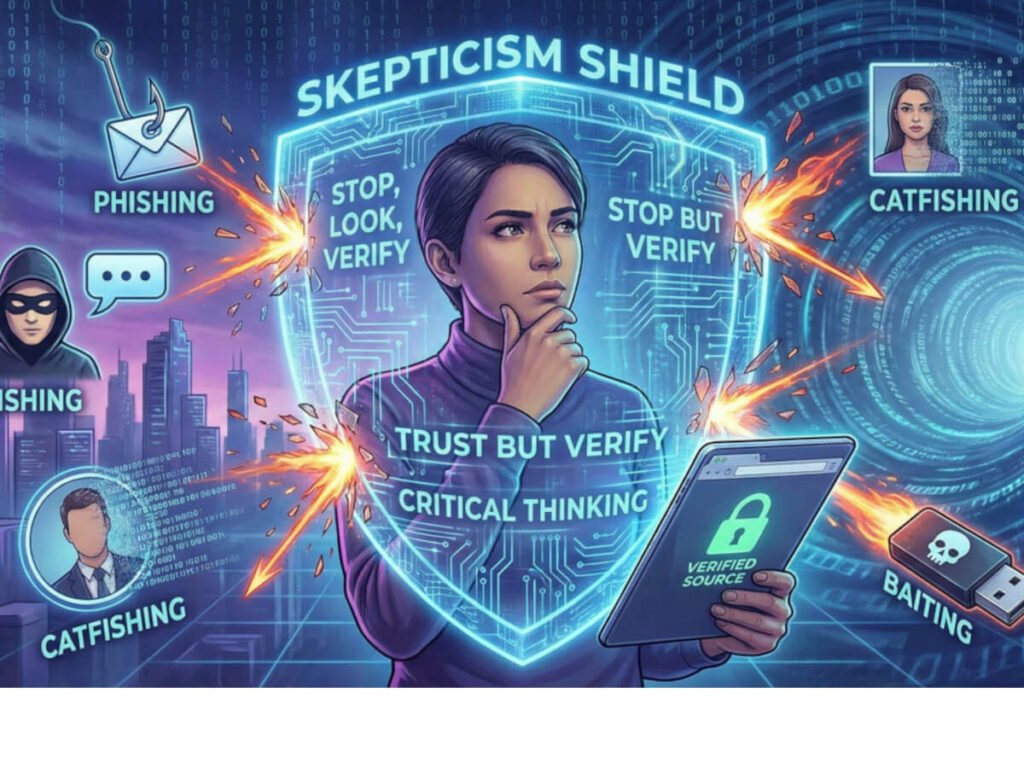
How do you protect yourself against threats that are constantly evolving? You adopt a “Zero Trust” architecture for your personal life.
1. Use a Password Manager
Humans are terrible at creating passwords. We reuse them, which leads to Credential Stuffing (where hackers use leaked passwords from one site to unlock accounts on another).
- Action: Use Bitwarden, 1Password, or Dashlane. Let them generate 20-character random passwords for every site. You only need to remember one master password.
2. Two-Factor Authentication (2FA) – The Right Way
Not all 2FA is created equal.
- Tier 3 (Weakest): SMS Codes. These can be intercepted via “SIM Swapping” attacks.
- Tier 2 (Good): Authenticator Apps (Google Authenticator, Authy, Microsoft Authenticator).
- Tier 1 (Best): Hardware Security Keys (YubiKey). These are physical USB keys you plug in. They are virtually unphishable because even if you are on a fake website, the key will recognize the domain mismatch and refuse to sign in.
3. The “Out-of-Band” Verification
If you receive an urgent communication (email, text, or phone call) regarding money:
- Hang up or stop reading.
- Verify independently. Find the official number on the back of your bank card or the official website.
- Call them back. Never use the contact details provided in the suspicious message.
4. Credit Freezing
In the US and many other jurisdictions, you can “freeze” your credit report. This prevents anyone (including you) from opening new lines of credit or loans in your name. It is free and is the single most effective way to prevent identity theft. You can temporarily unfreeze it whenever you need to apply for credit.
Part VI: What to Do If You’ve Been Scammed
Panic causes paralysis. If you fall victim, immediate action can sometimes recover funds or limit damage.
- Disconnect: If you downloaded software or gave remote access to your computer, disconnect from the internet immediately. Turn off the Wi-Fi.
- Contact the Bank: Call your bank’s fraud department immediately. If the transfer is recent, they may be able to reverse the wire or ACH.
- Change Credentials: From a different, clean device, change your passwords for your email and banking.
- Report It:
- USA:
ic3.gov(FBI Internet Crime Complaint Center). - Europe: Europol or local cybercrime units.
- Platform: Report the profile/listing to the website (LinkedIn, Upwork, eBay) to save future victims.
- USA:
Conclusion
The internet is a reflection of the real world—full of incredible opportunities and significant dangers. The goal of cybersecurity is not to be paranoid; it is to be prepared.
Scammers rely on your politeness, your panic, and your lack of attention. By slowing down, verifying sources, and utilizing modern security tools like password managers and hardware keys, you make yourself a “hard target.” In the economy of cybercrime, scammers prefer the path of least resistance. Don’t let that be you.
Stay skeptical. Stay secure.
Next Step for You
Would you like me to create a checklist based on this article that you can use to “audit” your own digital security (checking passwords, setting up 2FA, etc.)?
Bądź na bieżąco!
Zapisz się, aby nie przegapić nowości na Review Space.
Join Our Newsletter
No spam. Unsubscribe anytime.