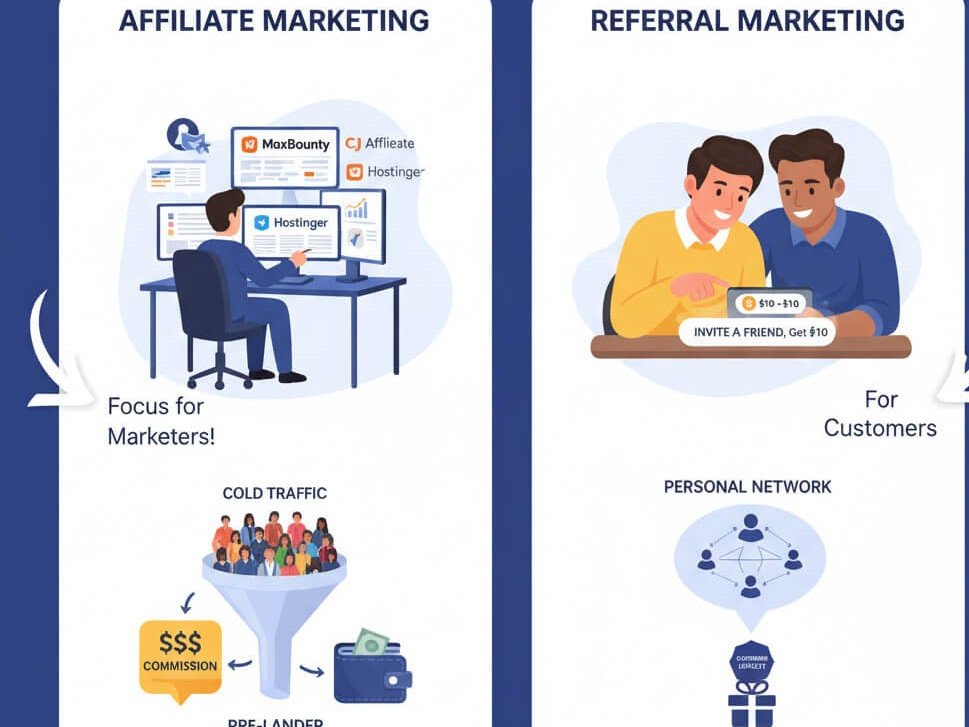
If you’re exploring ways to make money online, you’ve probably heard the terms “affiliate marketing” and “referral marketing.” Many people use them interchangeably, but the truth is, they are fundamentally different business models. Understanding the distinction between affiliate marketing vs referral marketing is crucial for anyone entering the online space.
One is a professional marketing strategy, while the other is a customer loyalty tactic. Choosing the right one depends entirely on your goals.
As someone navigating this world, I wanted to break down the key differences in a simple, no-nonsense way.
What is Affiliate Marketing?
In short: Affiliate marketing is a professional, performance-based business relationship.
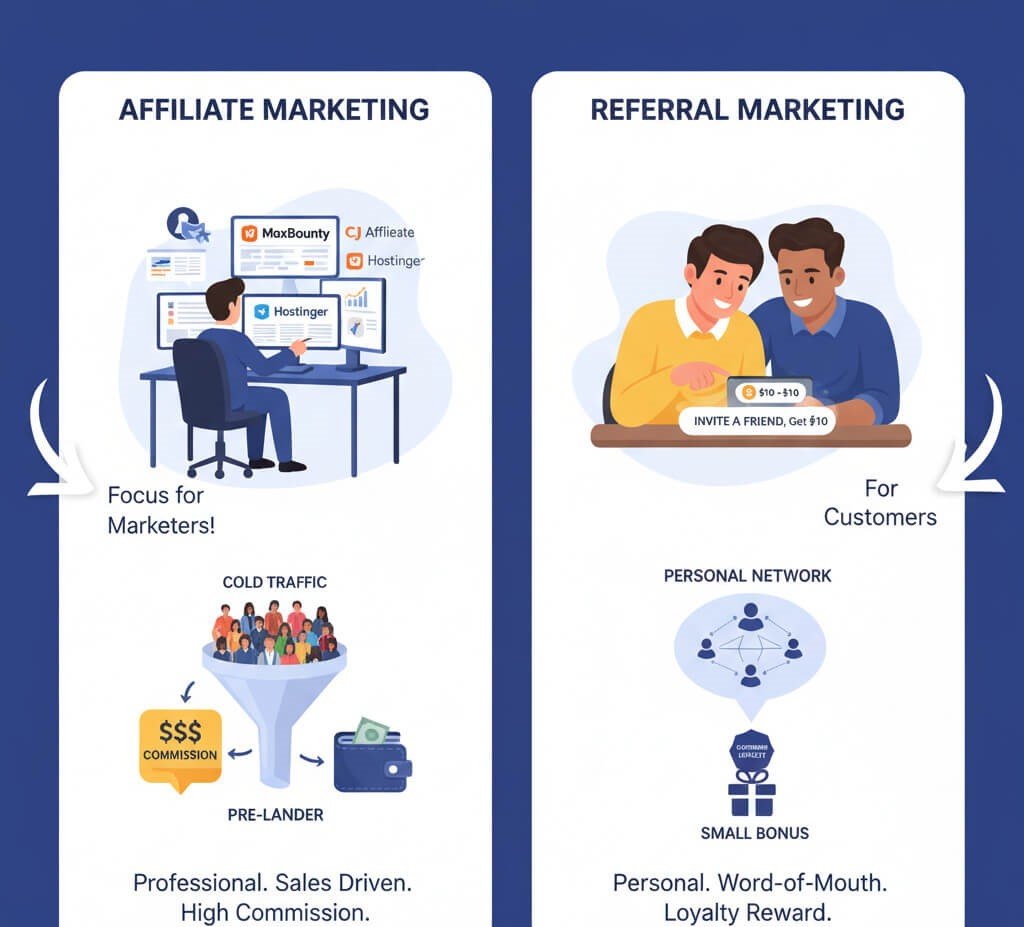
You act as a “publisher” or “affiliate” (a partner) for a company. Your job is to promote that company’s products or services to a broad audience, often people who have never heard of you or the product before (“cold traffic”).
Your goal is to generate a specific result: a sale or a lead. In return, the company pays you a commission. This is a business transaction.
- Who participates? Anyone can join an affiliate program (like the ones on MaxBounty or Hostinger). You don’t have to be a current customer.
- What’s the goal? To drive a high volume of sales or leads by using professional marketing tools and strategies.
- What are the tools? You use affiliate networks (like CJ Affiliate), dedicated ad platforms (like RichAds), and assets you create (like pre-landing pages, banners, and blogs).
What is Referral Marketing?
In short: Referral marketing is a digital “word-of-mouth” recommendation.
This model is built on personal relationships. A company encourages its existing, happy customers to tell their friends and family about the product.
- Who participates? Almost exclusively existing customers. You are a “referrer” or a “friend.”
- What’s the goal? To invite friends from your personal network (email contacts, social media friends).
- What are the tools? The company gives you a simple “Invite a Friend” link, usually found in your customer dashboard. The main incentive is often a two-way reward (e.g., “You get $10, your friend gets $10”).
- What’s the reward? Usually a small, one-time bonus, a discount coupon, or credits for your next purchase. It’s a “thank you” for your loyalty, not a primary income source.
Affiliate vs. Referral: Key Differences at a Glance
The easiest way to see the difference is with a side-by-side comparison.
| Metric | Affiliate Program | Referral Program |
| Essence | Business Relationship. A professional activity where you act as a marketer to promote products for a commission. | Personal Recommendation. A “word-of-mouth” system where a company encourages existing customers to bring in their friends. |
| Who Participates? | Anyone (who gets approved). You don’t need to be a customer. You are a “Partner” or “Affiliate.” | Existing Customers Only. You are a “Friend” or “Referrer.” |
| Your Goal | Sales & Leads. To attract a large number of new customers, often from “cold traffic” (paid ads). | Inviting Friends. To share a link with your personal contacts. |
| Tools | Affiliate networks (MaxBounty, CJ), pre-landers, banners, media buying (paid traffic). | “Invite a friend, get $10.” A simple link in your customer account. |
| Reward | High Commission. Can be a primary source of income (e.g., $20 per lead, 40% of sale). | Small Bonus. Typically a small, one-time reward (e.g., $10 for you, $10 for your friend, or a discount). |
| Example | Promoting a Hostinger plan or a MaxBounty offer on your blog for a high commission. | Your mobile operator’s “Bring a Friend” program. |
Which One Should You Focus On?
As a blogger, content creator, or media buyer, your focus should be on Affiliate Marketing.
Affiliate programs are designed for professionals like us who are building an audience and using marketing skills to promote products. They provide the tools, tracking, and, most importantly, the high commission rates that can turn into a real business.
Referral programs are great, but they are a tool for companies to leverage their customer base, not a primary income model for marketers.
Here on Review Space, we focus on mastering the world of Affiliate Marketing.
Bądź na bieżąco!
Zapisz się, aby nie przegapić nowości na Review Space.
Join Our Newsletter
No spam. Unsubscribe anytime.