What is Traffic Arbitrage? A Simple Guide for Beginners
(Introduction – What’s the Buzz About?) You might have heard the term “traffic arbitrage” floating around online earning communities, often surrounded by hype and confusing jargon. You might still be asking, what is traffic arbitrage? Is it a legitimate way to make money online, or just another complicated scheme?
The truth is, traffic arbitrage is a real online business model, but it’s often misunderstood. Forget the complex definitions for a moment. At its core, the idea is surprisingly simple: buy low, sell high. But instead of stocks or goods, you’re dealing with website visitors.
Therefore, this article is your no-nonsense starting point. We’ll break down the basic concepts – traffic, offers, CPA, CPL, CPS, verticals – using simple analogies, so you can truly understand what affiliate marketers actually do.
First Things First: What is “Traffic”?
Imagine a busy shopping mall. All the people walking around, looking at different stores – that’s foot traffic. Similarly, in the online world, “traffic” simply means website visitors. People browsing the internet, clicking links, visiting websites – they are the traffic. As an affiliate marketer, your job often starts with getting this traffic to go where you want it to go.
Okay, So What’s an “Offer”?
Think of an “offer” as the specific product, service, or action you are promoting. Essentially, it’s the destination you want your traffic to reach and interact with. Offers are provided by businesses (called “advertisers”) who want more customers or leads.
Analogy: If traffic is the people in the mall, the “offer” could be a special discount at a specific shoe store, a free trial for a new streaming service advertised on a kiosk, or a sign-up form for a store’s loyalty card.
Crucially, you don’t get paid just for sending people to look at an offer. You get paid when they take a specific action. This is precisely where those confusing acronyms come in. They describe how you get paid.
Understanding Payment Models: CPA, CPL, and CPS
CPA: Cost Per Action
First, CPA stands for Cost Per Action. This is the most general term. It means the advertiser pays you a commission whenever a visitor you sent completes a specific, predefined action. What action? That depends on the offer! Indeed, CPL and CPS (discussed below) are just specific types of CPA.
CPL: Cost Per Lead
Next, CPL stands for Cost Per Lead. Here, the desired action is generating a “lead” – usually capturing a potential customer’s contact information.
Action: The user fills out a form, signs up for a newsletter, registers for a free trial, or enters their email for a contest (like the Surveys and Sweepstakes offers we discussed!). They usually don’t have to buy anything.
Analogy: Imagine a company pays you $2 for every person you convince to sign up for their free email newsletter about gardening tips. In this scenario, you brought them a potential customer (a lead).
CPS: Cost Per Sale
Finally, CPS stands for Cost Per Sale. This one is straightforward.
Action: The user makes a purchase.
Analogy: You work as a salesperson on commission. Therefore, you only get paid if the customer actually buys the product. You might get a fixed amount or a percentage of the sale value. For instance, E-commerce offers (like promoting products from Aliexpress or local stores) usually work on a CPS basis.
Navigating the Market: What Are “Verticals”?
Just like a supermarket has different aisles (dairy, electronics, clothing), the world of affiliate offers is divided into categories called “verticals.” These are broad niches or industries. Understanding verticals helps you focus your efforts. Some common ones include:
- E-commerce: Promoting physical products from online stores.
- Finance: Credit cards, loans, insurance offers.
- Nutra (Health & Beauty): Supplements, skincare, weight loss products.
- Surveys/Sweepstakes: Offers where users sign up for paid surveys or enter prize draws (like the MaxBounty offers!).
- Gaming/Gambling: Promoting online games or casinos.
- Dating: Promoting dating sites or apps.
- Software/Utilities: Antivirus programs, VPNs, mobile apps.
So, How Does “Arbitrage” Fit In?
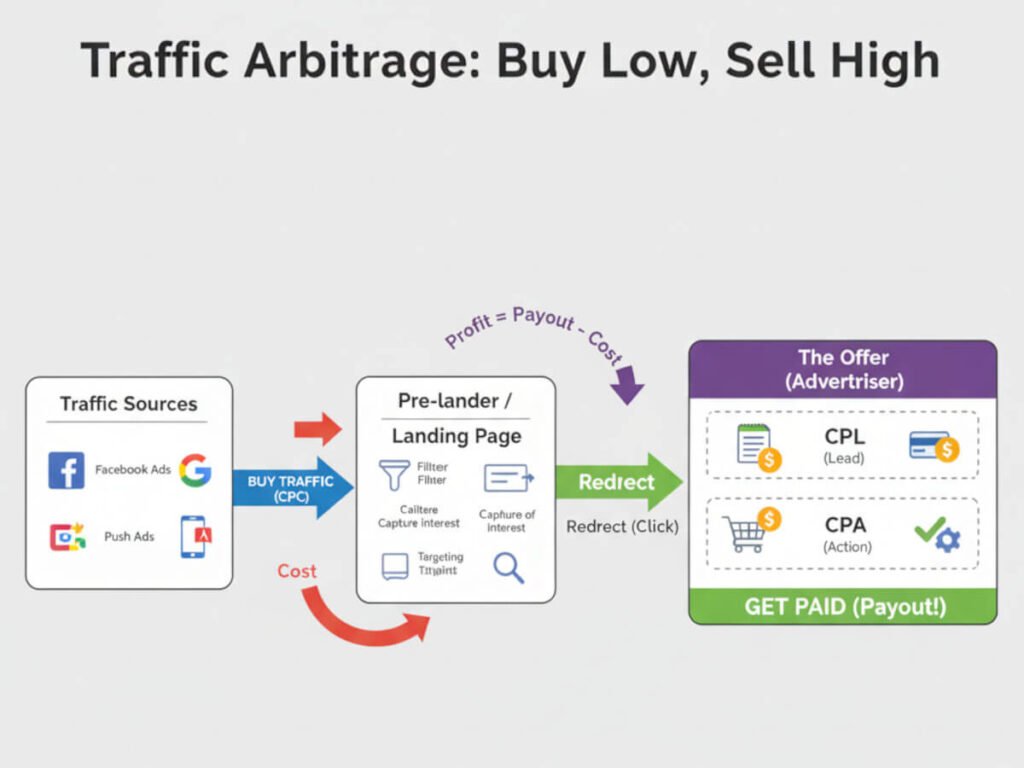
At its core, Traffic Arbitrage is the process of:
- Buying traffic from one source (like placing ads on Facebook, Google, or RichAds) at a certain cost (your CPC – Cost Per Click).
- Sending that traffic to a specific Offer (usually through your own intermediary page, called a pre-lander).
- Hoping a percentage of that traffic takes the desired Action (CPL or CPS).
- Getting paid by the advertiser for those actions.
Your Profit = (Total Payout from Advertiser) – (Total Spent on Ads).
The “arbitrage” happens when you can consistently buy traffic for less than you earn from the resulting actions.
The Million-Dollar Question: Is It Easy?
Honestly? No. Traffic arbitrage is simple in concept but complex in execution. Indeed, it’s not a get-rich-quick scheme. It requires:
- Learning and understanding the tools (ad platforms, tracking).
- Analytical skills (reading data, calculating ROI).
- Testing and optimization (most tests fail!).
- A budget to invest (and potentially lose).
- Persistence and patience.
In conclusion, traffic arbitrage boils down to buying website visitors cheaply and directing them to offers where they convert profitably. Understanding the basic terms – Traffic, Offer, CPA/CPL/CPS, and Verticals – is the very first step on this challenging but potentially rewarding journey.
Stay tuned to this blog as I share my own experiences, mistakes, and learnings navigating this world!
Bądź na bieżąco!
Zapisz się, aby nie przegapić nowości na Review Space.
Join Our Newsletter
No spam. Unsubscribe anytime.